
Let’s start with a hard truth…
… people who work all day, often until late, no longer have the time or mental bandwidth to adapt to rigid store hours: 9 am – 1 pm, 3 – 7 pm, closed on Sundays, etc.
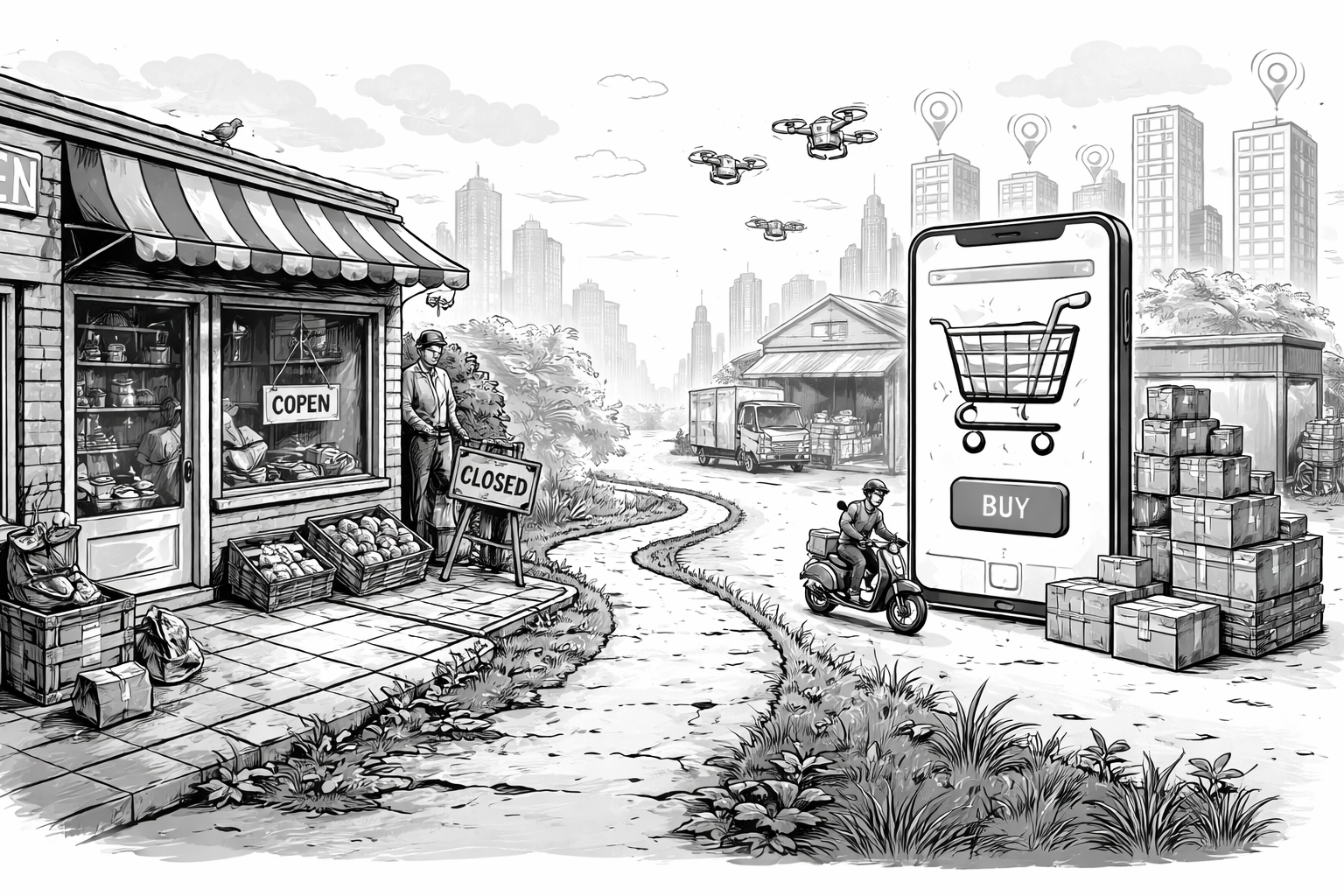
About the image above: “COPEN?” ChatGPT’s is crazy…!!!
In this context, e-commerce hasn’t ‘stolen’ Customers; it has solved a real need – CONVENIENCE – exceptionally well.
Making a purchase in a few seconds, during a break at the office or from the comfort of one’s sofa, is simply more aligned with modern life.
Thinking that small retailers can compete on this terrain is illusory.
Large platforms operate with economies of scale, logistics capabilities and investment power that are far beyond the reach of local players.
And yet, while we celebrate efficiency, we are underestimating the systemic cost of this transformation.
Proximity stores are not just points of sale.
They are critical nodes in a short supply chain that supports local producers, artisans and small manufacturers.
They are economic and cultural infrastructures that hold together territories, skills and identity.
When a neighborhood store closes, we don’t just lose a shop sign, we break a valuable chain: producer, distributor, retailer, consumer.
Economic biodiversity shrinks.
Dependence on external systems increases, often irreversibly.
The point, then, is not to nostalgically defend the past but to redefine the role of proximity retail.
The stores that have a future are those that stop competing on convenience and start building value around what online cannot easily replicate: experience, relationships, curated selection, expertise and service.
In other words, this is not about resistance, it’s good old positioning.
Andy Cavallini
 On Retail
Leave a comment