
In Luxury Retail, everyone agrees culture matters – the question is: “How do we make it tangible, repeatable and scalable across every store?”
Here are a few ideas.
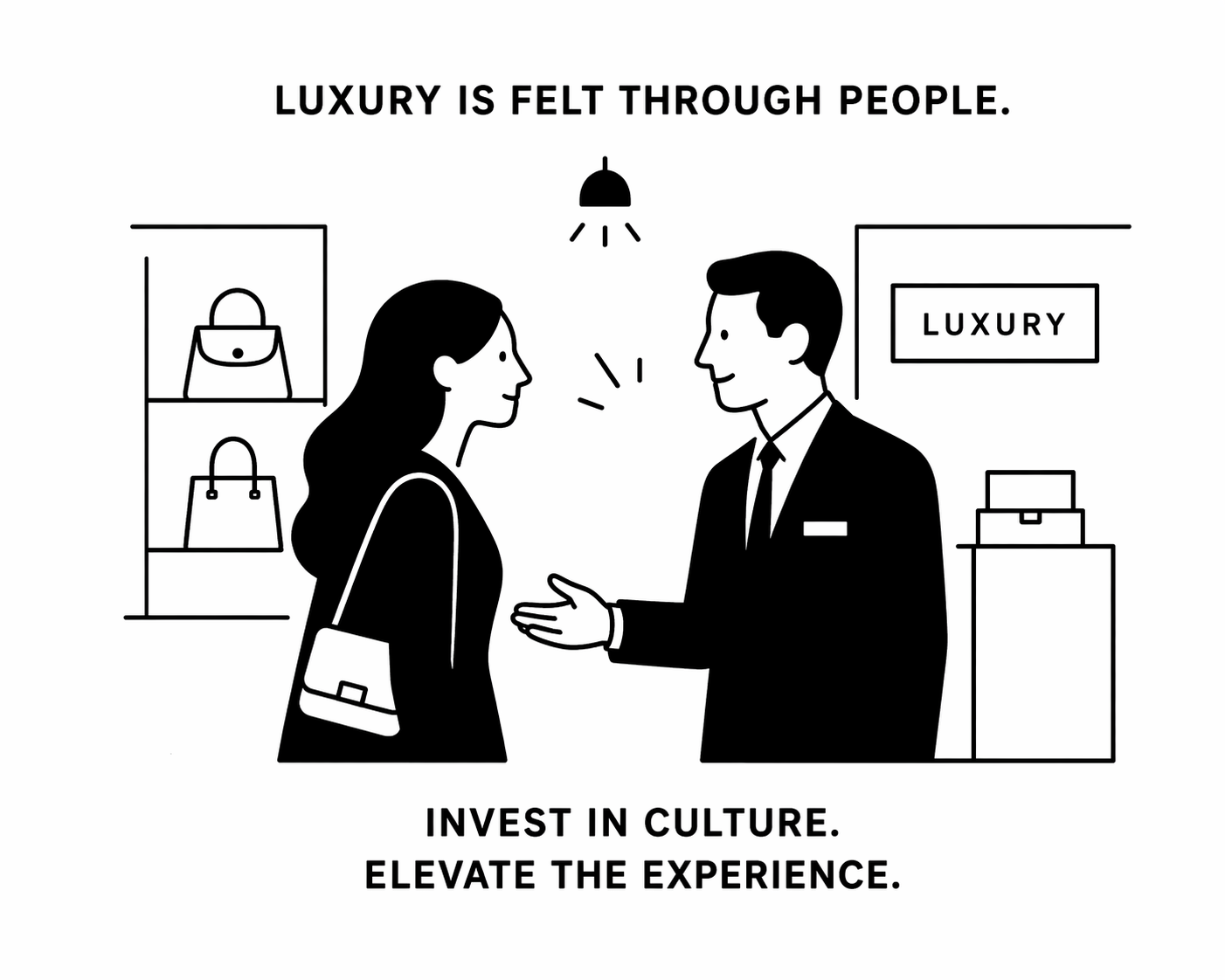
Translate values into observable behaviors.
Most Brands stop at values, they define words like excellence, craftsmanship, client-centricity; but words don’t scale, behaviors do.
Operationalizing culture starts with a simple but demanding discipline: turning every value into specific, visible actions.
Client-centricity, for example, cannot remain an abstract intention, it must become something you can actually see on the floor. It shows up in how a Client is greeted, in the quality of eye contact, in the ability to ask a contextual question before presenting a product, in the effort to personalize even a small detail of the interaction.
If you can’t observe it, you can’t train it; if you can’t train it, you can’t scale it.
Design the emotional journey, not just the Customer journey.
Luxury brands are exceptional at designing environments: they control layout, materials, lighting, product placement; they define service steps with precision.
And yet, Customers don’t remember steps, they remember how they felt.
Operational culture requires a shift: mapping not only what happens, but what the Client should feel at every stage of the experience.
From the moment of entry, the Client should feel recognized; during exploration, they should feel confident; when approaching a decision, they should feel reassured. And when leaving, they should feel elevated.
Store Associates: hire for alignment, not just competence.
Most hiring decisions in Retail are optimized around experience, product knowledge and sales ability.
But Luxury does not require more people who can sell, it requires people who can embody the brand in a way that feels credible, this means selecting individuals with emotional intelligence, presence, curiosity and the ability to connect across social distance.
Technical skills can be taught, authenticity cannot.
No more scripts.
Scripts create consistency, but they also create distance – and in Luxury, distance quietly destroys the experience.
Instead of prescribing exact sentences, strong cultures define principles of interaction; they clarify the tone, the intention and the boundaries within which people can move.
A greeting, for instance, should not be memorized, it should feel intentional rather than transactional, it should acknowledge the Client as an individual and adapt naturally to the context, whether the store is busy or quiet, whether the Client is new or returning.
Training in Luxury Retail .
Training in Luxury Retail often focuses on product details, brand heritage and selling techniques.
All of this is necessary, but none of it is sufficient.
The moments that define the experience are rarely predictable, they emerge when a Client hesitates, when expectations are unclear or when something goes wrong.
These situations cannot be scripted.
The objective of training, therefore, must evolve, it is no longer about knowing what to say, but about knowing how to decide. This requires exposing teams to ambiguity through scenarios, role plays and discussions of real situations where there is no obvious right answer.
Align incentives with experience, not just sales.
What an organization measures inevitably shapes behavior. If performance is evaluated only through revenue, conversion or average transaction value, teams will optimize for transactions, even when it comes at the expense of the experience.
Operationalizing culture means introducing signals that reinforce what truly matters; it means paying attention to the quality of Client feedback, the ability to build repeat relationships and the recognition of meaningful service moments observed on the floor.
Sales metrics remain important, but they must be balanced; otherwise, culture will always be secondary.
Make store leaders the carriers of culture.
Culture lives in stores, not in the headquarters.
And more precisely, it lives in the people who lead them; if a Store-manager does not embody the culture, no training program will compensate for it; standards will slowly drift and behaviors will deteriorate.
Leadership in this context is not only about performance, it is about shaping the energy, the tone and the emotional climate of the store; it is about reinforcing expectations daily, through what is encouraged, what is corrected and what is tolerated.
Additionally, culture is not built through occasional initiatives, it is built through repetition.
It takes shape in daily briefings that focus on a single behavior, in real-time feedback during Client interactions, in small coaching moments that happen on the floor; it grows through regular reflection on actual experiences, by sharing what worked and what didn’t.
Final thought
The real battleground is neither the product nor the space, it is the moment in which one person meets another, and something is either felt or not.
Operationalizing culture means taking something intangible and making it present, every day, in every interaction, and that requires intention, discipline and design.
 On Retail
Leave a comment